
Urban Forest-River Corridor Committee
The Urban Forest/River Corridor Committee is a committee of Town Council made up of volunteers and one member of Council. The committee meets monthly, and meetings are open to the public.
What We Do
The committee communicates with Town Council and staff on issues regarding the protection and enhancement of urban trees through conservation, planting, and maintenance, as well as issues that affect the water quality of the Mississippi River.
The committee also:
- educates residents, developers, and staff about the importance and value of urban trees
- reviews residential, commercial, and industrial developments to assess their environmental impact and ensure proper tree selection and placement
Programs
Residential Tree Planting Program
Since 1998, the Town has made trees available to residents for residential planting. Each spring, residents can register a request for a tree, select a tree from a list of available species, and attend a tree planting workshop.
Tree profiles with descriptions, usage tips, and care guides are available on the online service portal. Bare root trees may be purchased seasonally through the portal.
A Quick Guide to Planting Bare Root Trees
Plan Ahead
Plant your tree during the dormant seasons — spring or fall. Visualize your yard and consider your tree’s future height and shape. Avoid planting under utility lines and keep a safe distance from structures.
| Tree size | Distance from power lines | Distance from home |
|---|---|---|
| Small trees (under 7 m) | 2 m | 3 m |
| Medium trees (7–18 m) | 6 m | 4 m |
| Large trees (over 18 m) | 12 m | 5 m |
Prepare the Spot
Clear a 50 cm radius of grass and weeds. Dig a hole twice the size of the root system — an ideal home for your tree’s roots.
Minimize Stress
During transport, keep roots moist. This is crucial. Think wet burlap or mulch to shield them. Don’t let branches get bruised — handle with care.
Planting Time
Get the tree in the ground as soon as it arrives. Straighten out its roots, letting them fan out comfortably. Protect them from direct sun and wind to prevent drying out. Place the root crown on a mound in the hole, fill halfway with soil, tamp down to remove air pockets, fill with water, then top off with soil. Shape a ridge around the base to help with watering.
TLC – Water, Stake, Mulch
Water your tree deeply, especially during dry spells. Mulch around the base to keep moisture in, but leave space around the trunk to prevent rot. Stake if needed for support against wind.
Remember to visit OntarioOneCall before you dig, to avoid utilities. With these easy steps, your tree will flourish and contribute to Carleton Place, one tree at a time.
Resources:
- 2026 bare root tree planting presentation (video)
- 2026 bare root tree planting presentation slides (PDF)
Commemorative Trees Program
Residents wishing to commemorate specific people, events, or occasions may have a tree planted through the Commemorative Tree Program.
Through this program, the Town will assist families or groups who wish to have a bench installed, or a tree planted, in a Town location (park or streetside) in remembrance of an individual or in celebration of an anniversary.
Read the Commemorative Bench and Tree Program brochure (PDF) for more information.
The Benefits of Trees
Trees are one of nature’s most powerful energy savers and water purifiers. Urban forests have substantial benefits to municipalities (stormwater attenuation, air quality mitigation, tourism, health care costs, and more), to residents (property value, energy conservation, and more), and to businesses (tree care companies, the nursery industry, and the aesthetics of retail areas).
1. Trees Improve Health
- Trees make the air more breathable by reducing particulate matter. Foliage helps settle out, trap, and hold particulate pollutants (dust, ash, pollen, and smoke) that can damage human lungs.
- One large tree can provide a day’s oxygen for up to four people.
- Trees absorb carbon dioxide and other harmful gases and, in turn, replenish the atmosphere with oxygen.
- Trees improve moods and emotions, creating feelings of relaxation and well-being.
- Trees provide privacy and a sense of security.
- Trees can act as buffers, absorbing a significant amount of urban noise.
2. Trees Save Energy
Deciduous trees provide shade and block heat from the sun during hotter months. By dropping their leaves in the fall, they let sunlight shine through in the colder months.
- Shade trees can reduce air conditioning costs. Carefully positioned trees can save 25 to 30 percent of energy consumption.
- Shade from trees over hard surfaces such as driveways, patios, and sidewalks minimizes landscape heat load.
- Evergreens planted on the north sides of buildings can intercept and slow winter winds.
3. Trees Add Natural Character to Our Cities and Towns
- Trees provide colours, flowers, and beautiful shapes, forms, and textures.
- Trees add interest by changing with the seasons.
- Trees and associated plants create habitat and food for birds and animals.
4. Trees Increase Property Values
- Healthy trees can add up to 20 percent to residential property values.
5. Trees Reduce Pollution
(See note below the checklist — this section currently has no content on the live page.)
6. Trees Conserve Water and Prevent Soil Erosion
- Trees reduce surface runoff from stormwater and prevent soil erosion and the sedimentation of streams.
- Trees may reduce the effects of flooding.
- Trees increase groundwater recharge to help make up for losses in paved areas.
- Trees prevent wind from eroding soil.
7. Trees Increase Economic Stability
- Trees enhance community economic stability by attracting businesses and tourists.
River Corridor

The Mississippi River is a tributary of the Ottawa River in eastern Ontario. It is over 200 kilometres long, from its headwaters at Mazinaw Lake to the Ottawa River, and has a drainage area of 4,450 square kilometres. The river flows through a number of communities, including Carleton Place.
The Urban Forest and River Corridor (UFRC) Advisory Committee provides advice and guidance to the Town on the following matters related to the river corridor:
- ensuring that historical development patterns and natural heritage resources do not negatively affect the river or the Town’s drinking water
- participating in the review of, and communicating with Town Council and staff about, proposed development and maintenance that will affect the river corridor and wetlands within the Town, to protect the river, water quality, fish habitat, and recreational uses
- reviewing projects to be undertaken by Town staff within the river corridor
- working with Town Council to educate residents, developers, and staff on appropriate environmental procedures to protect the integrity of the river corridor
- working with Town Council and staff on implementing the Source Water Protection Plan and providing recommendations to protect the Town’s drinking water
- providing advice on Town policies — including, but not limited to, the Official Plan, development permits, bylaws, and guidelines — that affect the river corridor
Spongy Moth and the Summer of 2021
Local Status
The spongy moth is an invasive, forest-defoliating insect found in Ontario that is now naturalized. Recent observations in Carleton Place indicate its populations are increasing. Few egg masses were found in the fall of 2020, so the current population is largely made up of “blow-ins” carried by wind. The Urban Forest Advisory Committee has observed holes and caterpillars on every oak (Quercus) in Town, as well as on sugar maple (Acer saccharum) and basswood (Tilia americana). The outbreak is expected to last two to three years.
Characteristics and Life Cycle
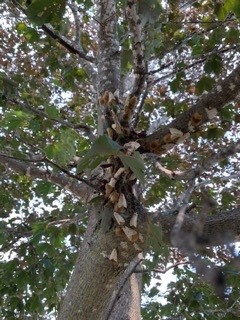
The European spongy moth is an invasive insect native to Europe. It is currently established in much of eastern Canada. The caterpillar stage of this insect feeds on the leaves and foliage of a large number of hardwood and softwood trees, and can feed on over 300 plant species, including landscape and garden plants.
Oak (Quercus) is the preferred species of the spongy moth. Other hosts range from birch (Betula) and aspen (Populus) to hardwoods such as sugar maple (Acer saccharum) and American beech (Fagus grandifolia), and softwoods such as eastern white pine (Pinus strobus) and Colorado blue spruce (Picea pungens).

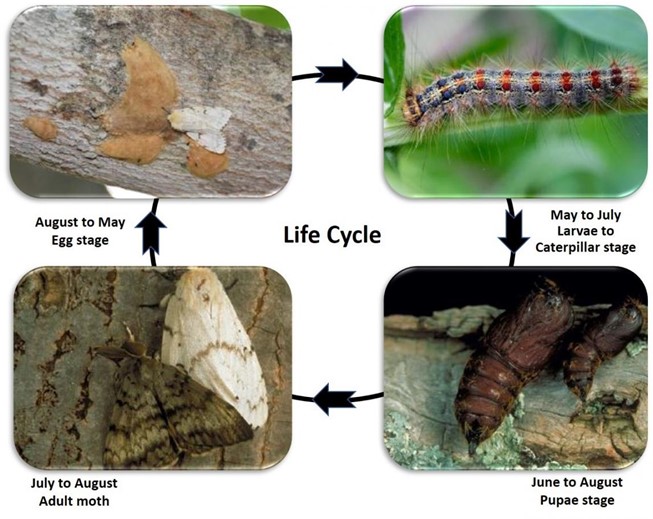
The spongy moth life cycle:
- overwinters in the egg stage, often on the bark of trees
- in spring, eggs hatch and larvae ascend the trees to feed on new foliage
- feeding occurs during the day, but as caterpillars mature, feeding shifts mainly to night — which can delay detection of infestations
- mature larvae are 50 mm long, dark-coloured, and hairy, with a double row of five pairs of blue spots followed by a double row of six pairs of red spots down the back
- feeding is completed by July or August
Male moths are light brown and slender-bodied, while females are white and heavy-bodied.
Tree Impacts (Signs and Symptoms)
- spongy moth outbreaks can occur every seven to ten years
- larvae chew holes in leaves or devour entire leaves
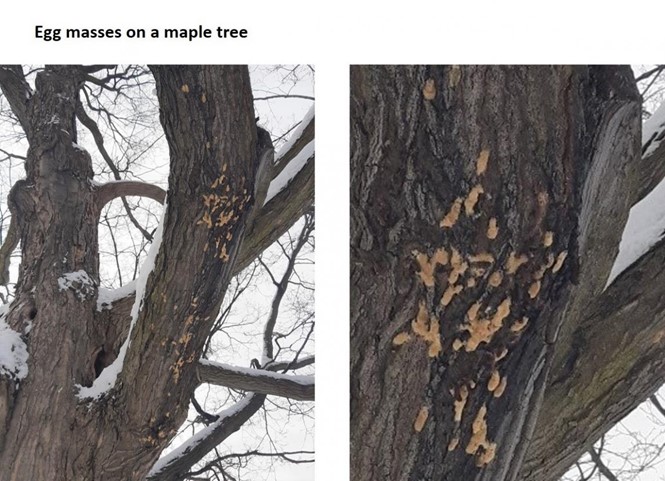
- in late July, spongy egg masses can be observed on the trunks and branches of infected trees, and on items such as outdoor equipment, trailers, and vehicles
- during severe outbreaks, trees and shrubs are completely defoliated over large areas; despite the trees’ ability to produce a new crop of leaves over the summer, the damage causes significant growth loss
- understory shrubs and plants may also be affected
Monitoring
Carleton Place, through the Forest Health Network, is communicating with other partners, such as the Ontario Ministry of Natural Resources and Forestry, who are monitoring increased populations of this insect in other areas of the province. The Town’s Urban Forest Advisory Committee, along with staff, continues to monitor this issue and will communicate to residents about spongy moth status in Town and best practices for control.
What Residents Might Notice
Residents may see large groups of caterpillars on tree trunks and branches, and some loss of leaves (defoliation), this spring as a result of this insect. Healthy trees are able to sustain some leaf loss, and some trees will produce a second flush of leaves in the same season. It is only repeated years of caterpillar feeding that cause concern for tree health.
What Residents Can Do
On their properties, residents can consider the following to reduce tree damage:
- during spring and summer, inspect outdoor equipment, trailers, vehicles, and firewood regularly for egg masses and caterpillars
- in spring, remove egg masses or larvae by scraping (PDF), then destroy them immediately by crushing the eggs or submerging them in a bucket of water and household bleach or soap for at least two days; after two days, discard the solution and egg mixture
- between May and early June, Btk (Bacillus thuringiensis kurstaki) can be purchased at a local hardware store and applied — always consult a knowledgeable professional about pesticide use
- in June and July, wrap burlap (PDF instructions) around the trunk of trees using a string, in a band around the trunk, folded in half; caterpillars often congregate in the burlap and can be disposed of daily in compost — caution: caterpillar hairs can cause skin irritation, so wearing gloves is recommended